
Symmetry and meet points
Consistent alignment and clean facet junctions contribute to a balanced, well-finished appearance. The proportions of the whole gem still matter more than one isolated measurement.
MJPLOY · PRECISION GEMSTONE CUTTING
Beautiful faceting starts by studying the rough. Its color, depth, inclusions and potential face-up appearance influence our choice of proportions, angles and facet positions.
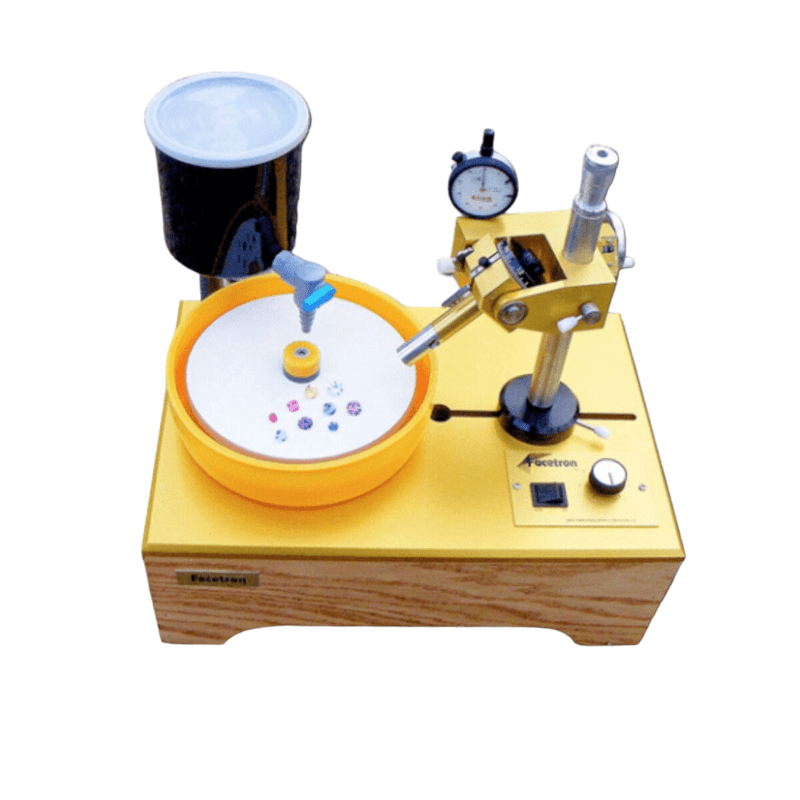
Official Facetron product photograph illustrating manual faceting, not a photograph of MJPLOY's automatic machine
MJPLOY · FACETING SERVICES
Have rough gemstones you would like cut to a particular design? Send us photographs, the material, approximate size or weight, and the shape you have in mind. We'll review feasibility, pricing and timing before any work is agreed.
IN THE WORKSHOP · A REAL PHOTO
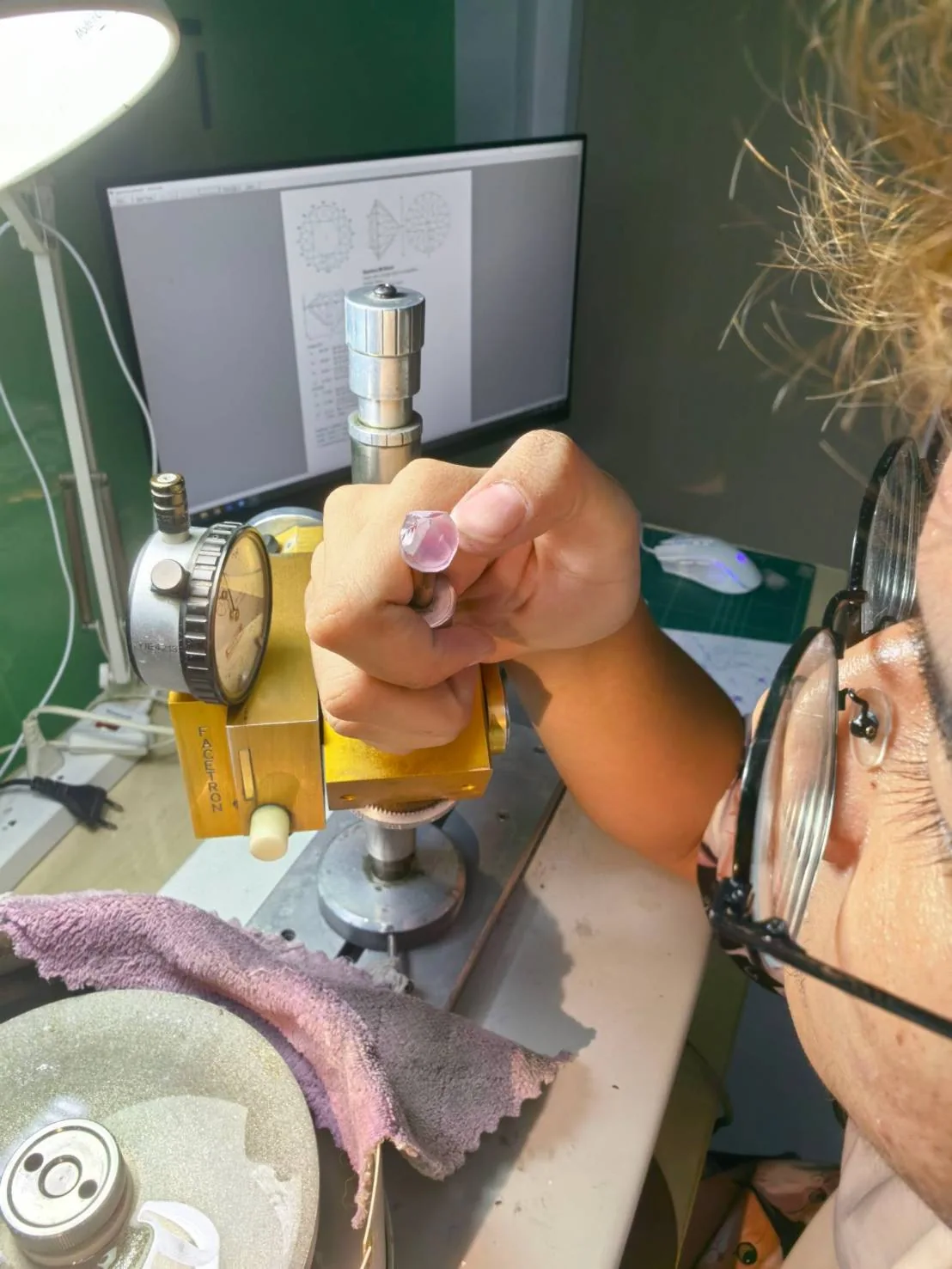
A cutting diagram gives us a plan, but the gemstone still has a say. Once it is on the dop, we keep checking its color, depth and inclusions. Sometimes the planned proportions work well. Sometimes a small adjustment is the better choice for the stone we actually have.
This is our own workbench: a Facetron faceting head, a gemstone on the dop and a design diagram on the screen behind it. The manual setup helps control angles and positions; the cutter still has to look closely and make the decisions.
01 · WHAT MAKES A PRECISION CUT
Precision is not simply a higher facet count. It is a series of choices about where each facet belongs, which angles are appropriate, and whether the result suits the individual gemstone.
Consistent alignment and clean facet junctions contribute to a balanced, well-finished appearance. The proportions of the whole gem still matter more than one isolated measurement.
Light return depends on facet angles, refractive index and viewing direction. One stone may benefit from a fuller color face-up, while another needs particular attention to windowing or dark regions.
The available rough, its inclusions and depth set practical boundaries. Removing excessive material merely to chase a theoretical symmetry target does not always benefit the finished gem.
02 · REAL FACETING DESIGN
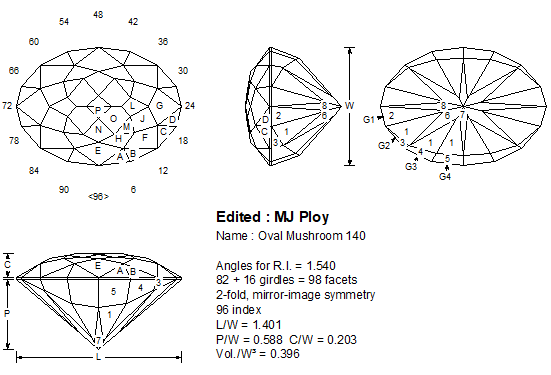
This is the actual Oval Mushroom 140 cutting diagram supplied by MJPLOY, credited “Edited: MJ Ploy.” It shows crown, pavilion, indexing and meet-point planning across different views.
A visual interpretation of the facet arrangement and overall shape before making physical cuts.
These figures belong to this example design; they do not describe every gem sold by MJPLOY. The uploaded file named .gif contained a single PNG still, so this release uses that still rather than claiming an animated rotation.
03 · FROM ROUGH TO POLISHED GEM
Choose a stage to see the decisions involved, from assessing the rough through measuring and presenting the finished stone.
01 / 06 · Cutting process
We first look at color distribution, inclusions, grain, outline and usable dimensions. A dark patch or an inclusion can change the orientation of the entire design.
02 / 06 · Cutting process
A faceting pattern specifies index settings, cutting angles and facet order. It remains a starting point: the refractive index, rough shape and available depth guide the final choices.
03 / 06 · Cutting process
Pavilion facets are established with attention to angle, index and depth. Their geometry strongly influences the pathways by which light may return toward the viewer.
04 / 06 · Cutting process
After the gemstone is transferred, crown facets and the table are worked in relation to the girdle and pavilion. The top view needs balanced proportions and carefully placed junctions.
05 / 06 · Cutting process
Smooth facet surfaces reduce visible scratches and haze. Polishing requires restraint so that previously established meet points are not unintentionally rounded or displaced.
06 / 06 · Cutting process
We check polish, meets, color, dark regions and overall face-up appeal under varied illumination, then document the actual dimensions and weight for the listing.
This educational process does not certify or guarantee the cutting grade of every listed gemstone.
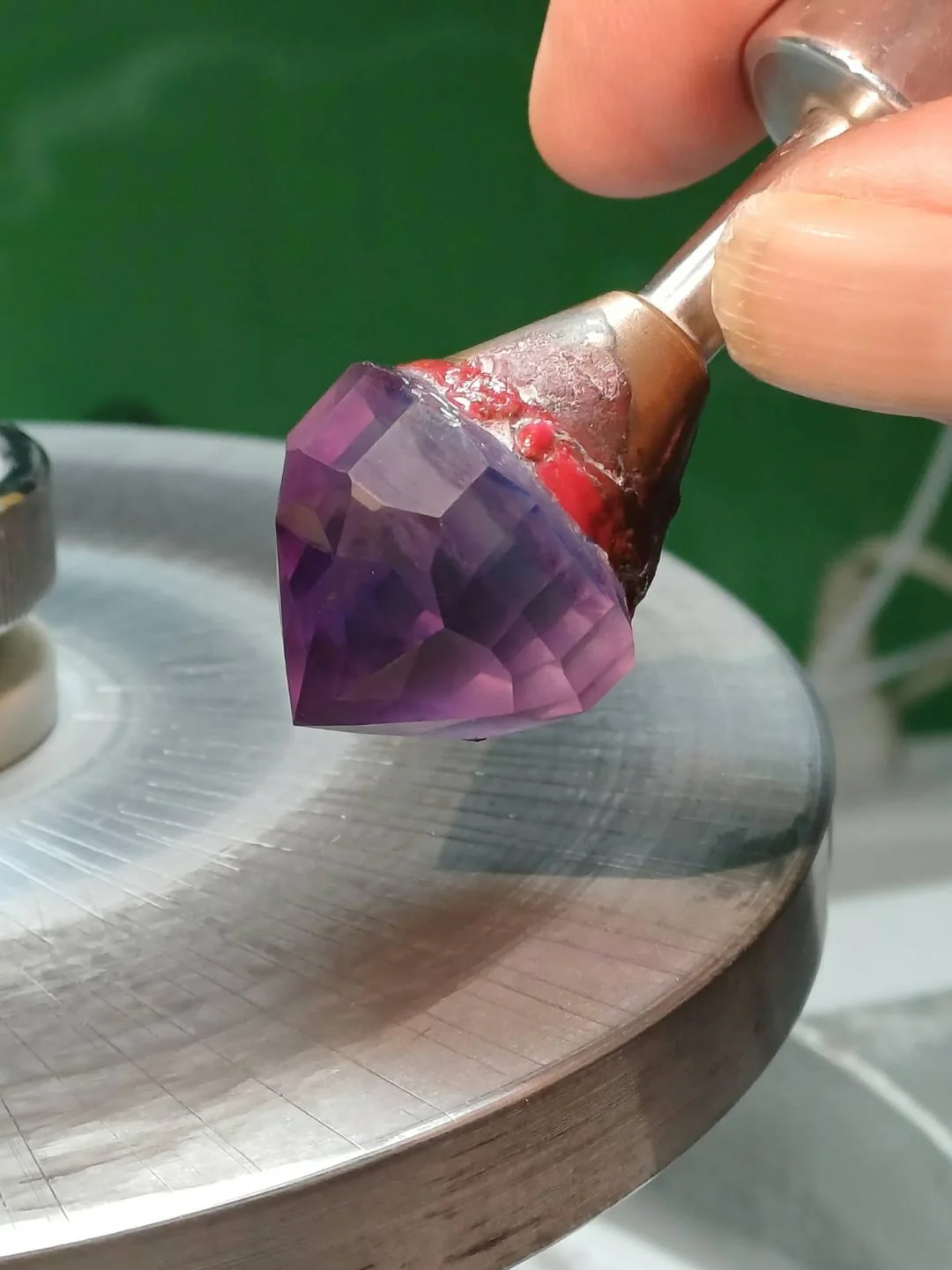
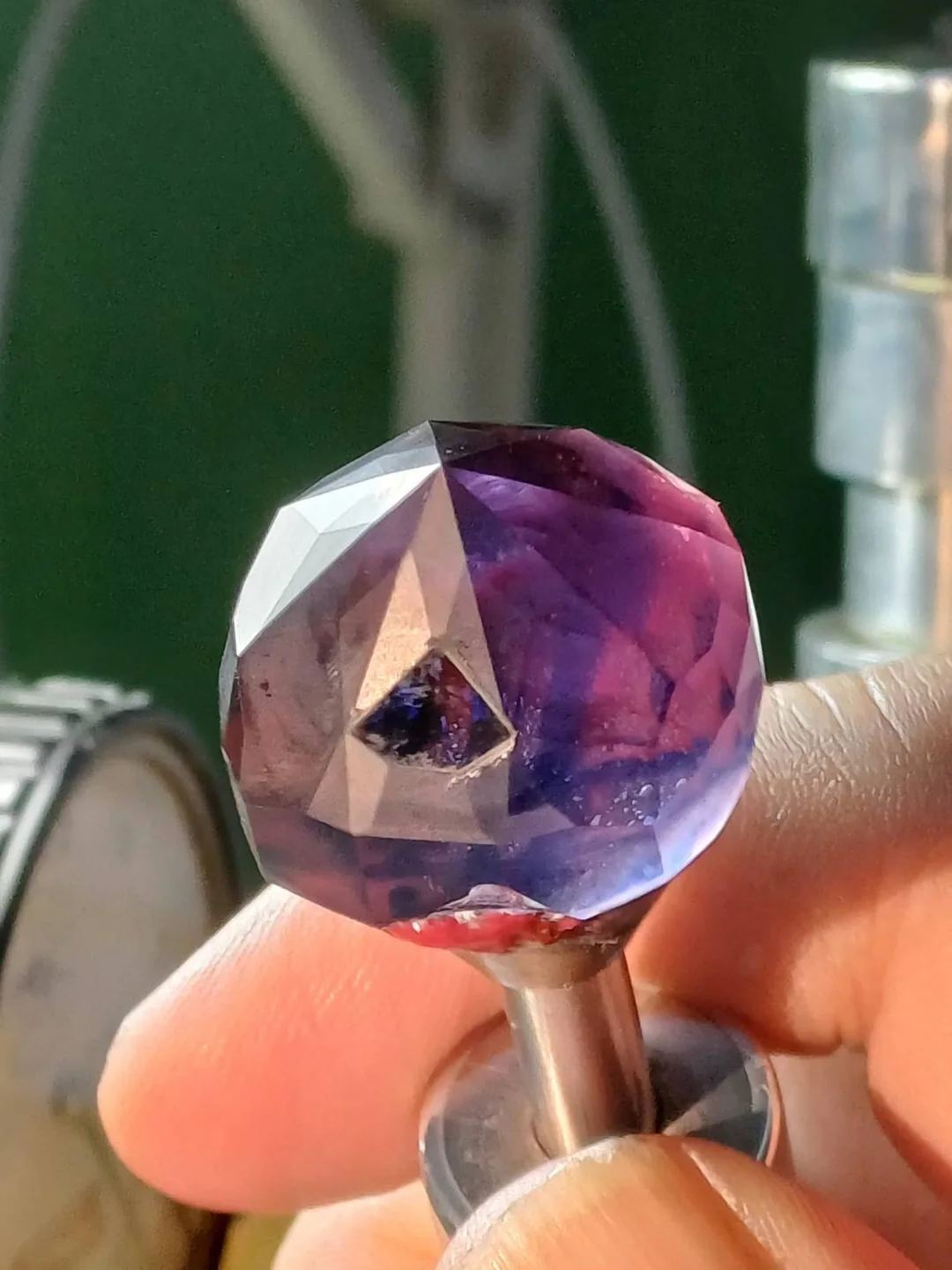
AT THE LAP · WORK IN PROGRESS
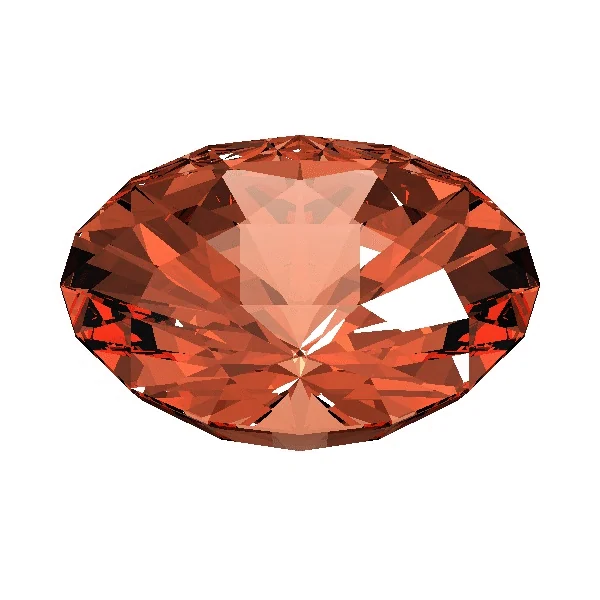
The purple gemstone in these photos was still being worked on. You can see facets beginning to come together, with more alignment and finishing to consider. These are workshop views—not a before-and-after comparison with the separate blue and orange finished gems below.
A front-facing look at the emerging facet pattern and areas where alignment matters.
Photographed beside the lap during cutting. The gemstone is not being presented as a finished, polished piece.
Actual workshop photographs. We have not assigned a gem species, carat weight or an exact cutting stage from these pictures alone.
04 · MANUAL FACETING EQUIPMENT
Manual faceting uses controlled angles, index positions and depth to bring facets into alignment. Yet the rough itself determines what can be preserved, how color is presented and which design is appropriate.
The pictured Facetron is a manufacturer's reference example of a manual mast-style faceting machine. The actual faceting head and lap arrangement in a workshop can differ from this model.
Explore the official Facetron machine ↗FACETRON® · Fac-Ette Manufacturing · manufacturer image for reference
05 · LIGHT RETURN CONCEPT
Light entering a faceted gemstone bends at the surface. Some of it may reflect from pavilion facets and return through the crown toward the viewer. Other paths can leave through the bottom or sides, contributing to areas that appear less bright.
No single angle guarantees maximum return for every material. Refractive index, depth, color, inclusions, viewing direction and lighting all influence the apparent result. Facet planning is about making informed compromises, not promising perfect light return.
06 · A CONSIDERED FINISH
We look at overall proportions, how accurately facets meet, the finish on each face, and the actual appearance of the stone in light. Sometimes a simpler pattern is a better choice for the rough than a complex one.
The comparison image is an educational illustration, not a before-and-after test of the same gemstone. A precision cut does not automatically outperform every commercial cut; real stone photos and videos are still essential when buying.
Explore available gemstones ↗FINISHED WORK · GEMSTONE EXAMPLES
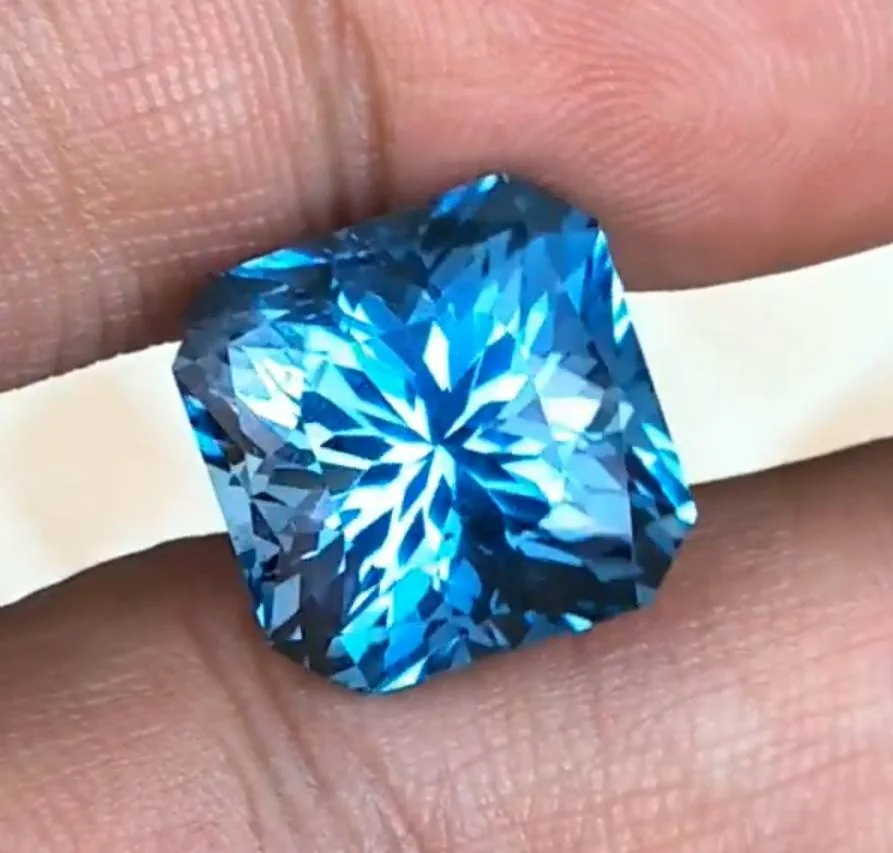
These are two separate examples of finished faceting work. Holding a gem in the light makes its color, facet pattern and shifting areas of brightness easier to appreciate than a flat drawing. A photograph is still only one moment under one set of lighting conditions.
Different facets catch the light as the stone is turned, creating a crisp pattern across the face.
A different outline and facet arrangement give this gemstone its own character.
The two finished examples are not the purple work-in-progress gem. No species, weight or measured optical performance is implied by these photographs.
07 · QUESTIONS & FACETING SERVICES
Have rough stones of your own, a particular cutting design in mind, or a parcel to be cut in batches? Here's how enquiries, estimates and next steps work.
Request a faceting estimate →CUSTOM AND BULK FACETING
We welcome enquiries for individual custom faceting projects. Send us photographs of the rough, its material and approximate dimensions or weight, plus the shape or design you would like. Each project is assessed for feasibility and quoted before work is confirmed. Send an enquiry ↗
Our bulk faceting service is being prepared and is not yet open for production orders. If you have a parcel or repeated cutting requirements, you can contact us now with the material, quantity, sizes and desired shapes for an initial discussion and estimate. Contact us about bulk work ↗
You can ask us to assess your own rough. We need photographs and basic material information first to judge whether the proposed cut is practical. Please do not ship any stones until we have agreed on the scope and receiving arrangements.
Yes, please share the design, diagram or reference you have in mind. We will look at the actual rough and explain whether the proportions are feasible or whether changes could help preserve weight, color or a sound shape.
Pricing depends on the gemstone material, size, condition, pattern complexity, quantity and finishing requirements. There is no universal per-carat or per-stone price for every job. Contact us for an initial assessment; a final quotation is confirmed before work starts.
Minimum quantities and lead times for bulk faceting have not been announced because the service has not opened. For an individual project, we review the stone, design and work schedule before agreeing on a timeframe.
Not necessarily. Material hardness, cleavage, fractures, inclusions and the available depth all matter. Some pieces are unsuitable for the intended shape or carry significant risks; we will discuss these before accepting a project.
Faceting removes material, so weight loss is unavoidable. Rough with fractures or cleavage may also chip or break. We discuss expected trade-offs, material risks and project terms before work is agreed.
Please share the gemstone type, photographs from several angles, approximate dimensions or weight, quantity, desired design and any preferred timeline. Our contact form accepts written details; send photographs or video separately through LINE, WhatsApp or email.
ABOUT CUTTING AND GEMSTONES
No. Visible brightness depends on material, refractive index, color, tone, transparency, proportions, angles and the lighting in which it is viewed. The individual stone matters.
Rough crystals differ in size, depth, color, inclusions and yield. The same pattern could waste too much material or fail to present a particular gemstone well.
No. It is an educational illustration, not an optical simulation, a laboratory report or data from any gemstone listed for sale.
Start with the listing’s actual photographs and dimensions. For additional available cutting details or videos, please contact us with the relevant product name or SKU.
WORKSHOP REFERENCE · AUTOMATION
COMING SOON · BULK FACETINGThis is a real photograph of our automatic faceting equipment, separate from the manual Facetron head shown earlier. We are preparing a faceting service for batches and parcels of gemstones. Bulk production orders are not yet open, but we welcome advance enquiries.
“Have a parcel of gemstones to cut? Tell us the material, estimated quantity, sizes and shapes you need. We would be happy to discuss feasibility and a preliminary quotation.”Enquire about bulk faceting ↗
Advance enquiries welcome · Acceptance, pricing and delivery dates subject to review
MJPLOY · GEMSTONES & FACETING SERVICES
Explore the real gemstones currently available, or send us details of a custom faceting project for an initial assessment.